Quitting vaping side effects: what's withdrawal and what isn't
Week one of quitting is a strange experience, because your body starts doing several things at once and gives you no labels for any of them. Some of it is nicotine withdrawal. Some of it is your airways recovering. Some of it isn't related to nicotine at all — and one common piece is almost certainly caffeine.
Sorting them apart matters, because "this is normal and ends" and "this needs looking at" are different situations, and lumping everything under "withdrawal" hides both.
The documented list
These are the symptoms named in public health guidance on nicotine withdrawal. Smokefree.gov, run by the US National Cancer Institute, lists:
- Cravings
- Feeling restless or jumpy
- Trouble sleeping
- Feeling irritable or grouchy
- Trouble thinking clearly or concentrating
- Feeling sad, anxious or depressed
- Feeling hungrier
Note what that list is mostly made of: mood, sleep, attention and appetite. Nicotine withdrawal is predominantly a neurological event, not a stomach one. Same guidance puts the strongest symptoms in the first few days, with the worst measured in days to a couple of weeks — matching the week-by-week vaping timeline.
If what you're feeling is on that list, it's textbook, it's temporary, and the peak is around day three.
The commonly reported extras
Here's where honesty is more useful than a longer list. Plenty of people quitting vapes report headaches, nausea, stomach upset, mouth ulcers and a cough or sore throat — and those are not in the official withdrawal lists. That doesn't mean people are imagining them. It means they have other likely explanations, and the explanations change what you should do.
Headaches. Extremely commonly reported in the first week. Worth knowing that dehydration, disturbed sleep and a sudden change in caffeine handling can all produce them independently, and all three tend to happen at once when you quit. See the caffeine section below before assuming it's the nicotine.
Cough, sore throat, or a throat that suddenly feels worse. Counter-intuitive but frequently described: people quit and their throat gets more irritated for a while before improving. The plausible reading is airway recovery rather than withdrawal — your airways clearing and re-sensitising after a long period of daily aerosol exposure. It should be improving, not worsening, after the first couple of weeks.
Stomach and bowel changes. Nicotine has a stimulant effect on gut motility, so removing it can slow things down — constipation is the more commonly described direction. Either way it's usually short-lived and responds to the boring advice: water, fibre, walking.
Mouth ulcers. Widely reported by people quitting both vapes and pouches. Usually settles within a few weeks.
Vivid or disturbed dreams. Very common, harmless, and often the first thing people mention. Sleep architecture shifting back is a plausible explanation, and it typically passes within a couple of weeks.
The one that catches nearly everybody: caffeine
This deserves its own section because it's the single most-missed cause of "withdrawal" symptoms, and unlike most things on this page, the mechanism is well established.
Smoking and vaping speed up CYP1A2, the liver enzyme that breaks caffeine down. So as a nicotine user you were clearing caffeine unusually fast. When you stop, that enzyme activity returns to normal and caffeine starts staying in your system considerably longer — meaning your unchanged three cups a day now behave like four or five.
The result: jitteriness, a racing heart, broken sleep, anxiety and a short fuse. Which is, unhelpfully, an almost perfect impression of nicotine withdrawal. A lot of people spend their worst week blaming quitting for what is substantially an accidental caffeine overdose, and some of them go back to vaping over it.
The test is easy: if week one feels wired rather than foggy and flat, cut your caffeine by about a third and see what happens over two or three days. Costs nothing, and it's the highest-yield adjustment on this page.
What isn't withdrawal at all
Two things worth separating out because they get misattributed constantly.
Weight gain. Real, but it's mostly appetite returning plus hand-to-mouth substitution rather than a metabolic catastrophe — the honest numbers are here.
The restless hands. Not chemical at all. The hand-to-mouth reflex is a separate learned habit that decays on its own schedule, which is why it outlasts the withdrawal by weeks. It needs a different fix — twelve of them here, and vapers need this more than smokers do because the device never left your hand.
When to stop reading blogs and ask someone qualified
Most of the above is uncomfortable and self-limiting. Some things are not, and I'd rather over-flag than under-flag: chest pain, difficulty breathing or breathlessness at rest, coughing up blood, a cough or throat problem that is still worsening after two to three weeks, fainting, or persistent heart palpitations. None of those should be filed under "probably just withdrawal" — see a doctor. The same goes for low mood that deepens rather than lifts, or any thoughts of harming yourself; nicotine withdrawal can affect mood, and that is a reason to get support rather than to wait it out alone.
I'm a developer who has come off three nicotine products, not a clinician (more on who writes this). This page separates documented guidance from commonly-reported experience on purpose, and it is not a diagnosis. A pharmacist is free in most countries and considerably better at this than a blog.
The short version
Mood, sleep, concentration, appetite and cravings: documented withdrawal, peaks around day three, largely done inside a fortnight. Headaches, throat and gut changes, dreams and ulcers: commonly reported, usually short, often have causes other than nicotine. Feeling wired rather than foggy: check your coffee first. Anything in the flagged list above: get it looked at.
The whole plan, if you're at the start of this, is in how to quit vaping. And if it feels harder than quitting cigarettes did, there are four structural reasons for that and none of them is that you're weak at it.
Watch the bad week become the good month
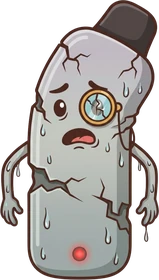
Stub Out keeps the score a vape never gave you — hours free, money saved, cravings beaten — while Nik, your addiction as a smug cartoon vape, falls apart stage by stage. Day three is worse for him than it is for you.